
In Mexico, for photovoltaic systems residential, commercial and industrial, Inverters can be primarily classified by their architecture and how they interact with the grid and batteries. The right choice depends heavily on installed capacity, type of connection, shading, backup power requirements, and whether storage will be available.
Main types of investors
| Guy | Typical application | Approximate power | Batteries | Main advantage |
| Microinverter | Home / small business | 0.3–2 kW per unit | It depends on the system. | Individual control per panel |
| Single-phase string | Small business/house | 2–12 kW | Normally not | Economical and simple |
| Three-phase string | Trade / Industry | 10–350+ kW | Normally not | Excellent scalability |
| Hybrid | Home / business / industry | 3–100+ kW | Yeah | Solar + battery + grid |
| Central | Industry / utility scale | hundreds of kW–MW | According to design | Large plants |
| Off-grid | Places without CFE | variable | Yeah | Independent operation |
| String + optimizers | House / business | variable | Optional | Optimization by module |
CFE even includes in its technical specifications both conventional inverters with multiple MPPTs (Maximum PowerPoint Tracking or Maximum Power Point Follower) as microinverters, and requires appropriate protection and interconnection characteristics.
1. Microinverters. One module is placed under each panel or for small groups of panels. Each module operates virtually independently. They are particularly useful for houses with shaded areas, roofs with varying orientations, or when individual panel monitoring is desired.
Examples available in the Mexican market include solutions from Enphase, Hoymiles and Growatt; Growatt, for example, presented its NEO line of microinverters in Mexico in 2026.
2. String Inverters. They are probably the most important architectural feature for both residential and commercial/industrial applications. Several panels are connected in series, forming a string. Current inverters can handle multiple strings and multiple independent MPPTs.
In residential settings, we typically find equipment of approximately 3–10/12 kW, While in industry there are three-phase string inverters of tens or hundreds of kW. For example, Growatt markets MAX equipment for C&I. 50–75 kW, 124–150 kW and up to 320–350 kW.
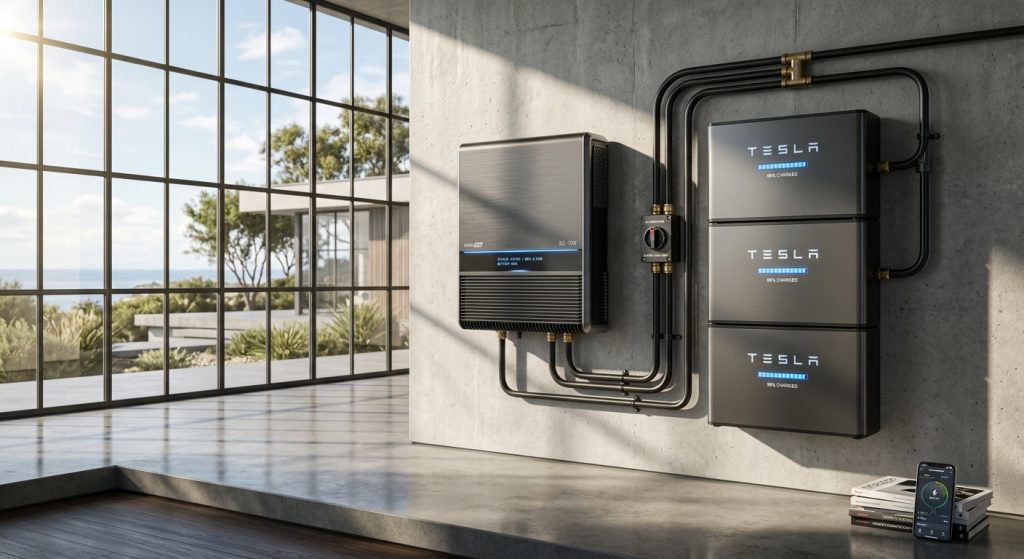
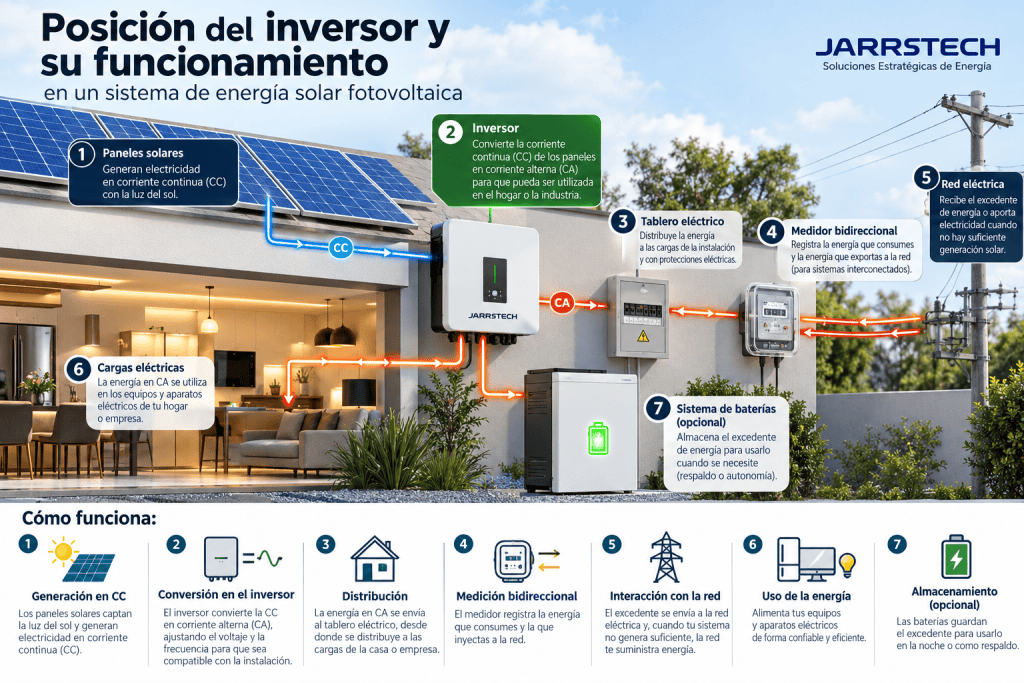
3. Hybrid investors. This category is growing a lot because it combines everything in one system Solar panels + CFE grid + batteries/BESS. The inverter can manage photovoltaic generation, consumption, battery charging/discharging, and grid exchange.
For JARRSTECH, this category seems particularly relevant technically because it allows for the construction of solutions for operational continuity, peak shaving and energy storage, Instead of limiting the project to selling solar panels, hybrid residential and commercial/industrial solutions of varying sizes already exist in Mexico. Growatt, for example, recently presented SPH and WIT systems for these applications.
4. Investors with optimizers. Here, each panel incorporates a DC optimizer, and the energy is then fed to a string inverter. It's an intermediate solution between conventional strings and microinverters: it allows for module-level optimization while maintaining a centralized inverter.
5. Central inverters. They are primarily used in very large industrial photovoltaic plants and solar power stations. Instead of installing numerous small inverters, large photovoltaic arrays feed high-power inverters. They are cost-effective on a large scale, although they concentrate more capacity in each unit.
For reference to the scale, a recent CFE specification for a large project contemplates Central inverters ≥3 MWac per unit or modular central inverters ≥1 MWac per module, and mentions requirements such as IEC 62109, UL 1741 and IEEE 1547.
6. Off-Grid Inverters. They are designed for installations that operate independently of the CFE (Federal Electricity Commission). They typically work with solar panels and a battery bank, and optionally, a diesel/gas generator. They are useful for ranches, telecommunications, remote installations, pumping, and specialized backup power. Currently, there are product lines specifically designed for this use available on the Mexican market.
For Mexico, I would separate the market into:
Small/medium house (3–10 kWp): Microinverter, single-phase string, or hybrid system. If there are shadows or different orientations, microinverters or optimizers have an advantage. If the client needs backup power during outages, a hybrid system with battery storage should be considered.
Large residential/commercial (10–30 kWp): string or hybrid, single-phase/three-phase depending on the electrical installation.
Commercial/industrial (30–500 kWp): Typically, distributed three-phase strings. This architecture allows for modularity and redundancy and can facilitate maintenance.
Industry with BESS: Hybrid/PCS inverters and energy management systems. Here the engineering changes considerably because batteries, EMS, peak shaving, demand control, backup power, and potentially grid services are involved.
MW plants: multiple high-power strings or central/central-modular inverters, depending on the project engineering.
An important point in Mexico is that It is not enough to select the inverter based on price and power.. For interconnected systems, it is necessary to verify the equipment's compatibility with the electrical requirements, protections, voltage/phases of the installation, and interconnection requirements. CFE currently maintains its Distributed Generation platform and documentation for interconnection requests, including for plants smaller than 0.5 MW. CFE Furthermore, CFE technical documents refer to standards such as UL 1741 and IEC 62109 for photovoltaic inverters.
An initial selection matrix in Mexico. The ranges are by product family; Before quoting, you must confirm the exact model, mains voltage, and current technical specifications.
| Brand / Family | Guy | Typical power | MPPT | Exit | Battery | Recommended segment |
| Enphase IQ8 / IQ8HC | Microinverter | ~0.3–0.4 kW/module | 1 per module | 208/240 V depending on the model | Yes, Enphase ecosystem | 🏠 Premium Residential |
| Hoymiles HMS | Microinverter | ~0.3–2 kW/unit | 1–4 | 220/240 V depending on the model | Through an additional system | 🏠 Residential |
| Huawei SUN2000 residential | String / hybrid | ~2–10 kW | 2 | Monophase | Yes, according to the family | 🏠 Residential |
| Fronius Primo GEN24 | String / hybrid | 3.8–10 kW | 2 | 208/220/240 V | Yes/according to version | 🏠 Premium Residential |
| Growatt residential | String / hybrid | ~3–15 kW | 2+ | Single / three-phase | Yes, according to the model. | 🏠🏢 Residential/Commercial |
| GoodWe ES/ET | Hybrid | ~3–30 kW+ | 2+ | Single / three-phase | Yeah | 🏠🏢 Solar + storage |
| Solis S6 residential | String / hybrid | ~2.5–10 kW+ | 2+ | Single / three-phase | According to family | 🏠🏢 Residential/Commercial |
| Sungrow Residential | String / hybrid | ~3–20 kW+ | 2+ | Single / three-phase | According to family | 🏠🏢 Residential/Commercial |
| SolarEdge + optimizers | Optimized string | ~3–10 kW+ | Panel optimization | Single / three-phase | According to the system | 🏠🏢 Complex roofs |
| Huawei SUN2000 C&I | String | ~30–150 kW+ | Multiple | Three-phase | BESS via compatible architecture | 🏭 Industrial |
| Solis S5/S6 C&I | String | 25–255 kW | Multiple | Three-phase | According to architecture | 🏭 Industrial |
| Sungrow SG C&I | String | ~33–350 kW | Multiple | Three-phase | PCS/BESS available | 🏭 Industrial |
| Growatt MAX | String | ~50–350 kW | Multiple | Three-phase | Separate BESS solutions | 🏭 Industrial |
| SMA Sunny Tripower CORE | String | ~50–125 kW+ | Multiple | Three-phase | According to architecture | 🏢🏭 Commercial/Industrial |
For example, Fronius currently publishes for Mexico the Primo GEN24 5.0 With 2 MPPTs, a maximum PV input of 5.15 kW, and a nominal output of 208/220/240 V, the family reaches up to 10 kW. Enphase maintains the IQ8 family for Mexico and has already documented commercial IQ8 microinverters. Solis, for its part, documents families ranging from residential S6 units to C&I systems of 100–110, 125, and 255 kW, clearly demonstrating the breadth of the string segment.
Quick matrix for selecting technology
| Project condition | Technology that should be evaluated first | Reason |
| 3–5 kWp house without shadows | String | Less complexity |
| House 5–10 kWp | String / hybrid | Good cost-capacity ratio |
| Roof with shadows | Microinverter / optimizers | Individual module management |
| Various panel orientations | Microinverter / Multiple MPPT | Better use |
| Customer wants support | Hybrid + battery | Operation during outages, as designed |
| Commercial 10–50 kWp | Three-phase string | Scalable |
| Commercial 50–200 kWp | C&I three-phase string | Modularity |
| Industry 200–500 kWp | String C&I | Multiple MPPTs and redundancy |
| Industry >500 kWp | High-power string C&I / central | CAPEX/O&M Assessment |
| Industry with high peak demand | FV + BESS + EMS | Peak shaving |
| Critical load | FV + BESS + EMS/ATS | Business continuity |
| Site without CFE | Off-grid/hybrid | Isolated operation |
An important detail for Mexico is the electrical voltage. Don't buy an inverter just because it says "three-phase". You need to verify if the project is in 127/220 V, 220/127 V, 220 V three-phase, 440/480 V, etc., and verify that the specific inverter version is compatible. Fronius, for example, expressly specifies 208/220/240 V for certain GEN24 models intended for this market.
JARRSTECH divides the catalog into 4 solutions
Affordable residential: 3–10 kW string. The priority would be cost, availability, warranty and technical service.
Premium residential: Enphase/microinverters or string inverters with optimization. Enphase maintains specific documentation for Mexico for the IQ8 and its various versions.
Residential with backing: Hybrid inverter + battery. Here I wouldn't just sell "solar panels" anymore, but energy security and continuity.
Industrial JARRSTECH: Three-phase string inverters + optional BESS + EMS. This fits particularly well with an energy engineering offering: PV generation, peak demand reduction, backup power, power quality, monitoring, and operational continuity.