
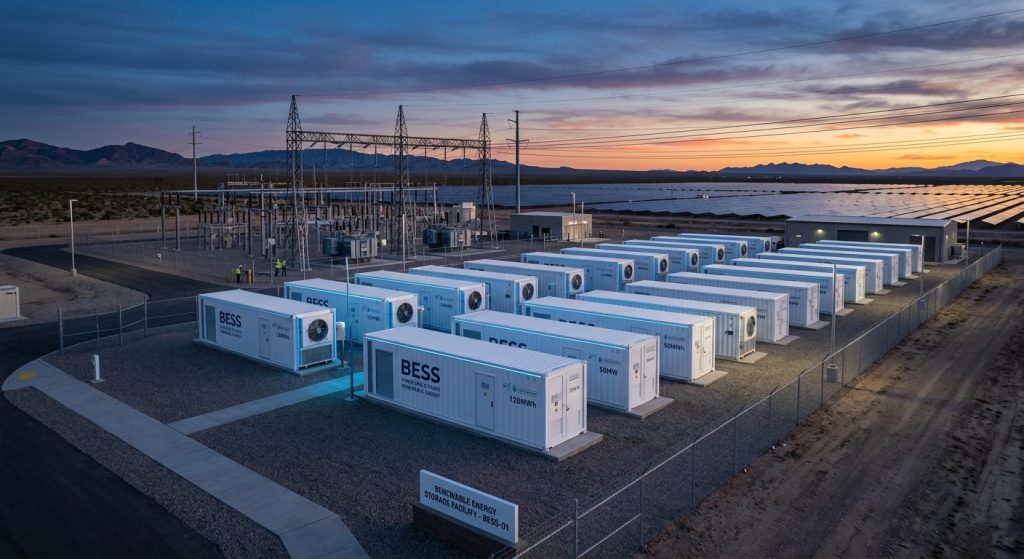
The BESS (Battery Energy Storage Systems) They are electrochemical storage systems capable of to capture electrical energy, store it and return it to the grid or to an industrial facility when it is technically or economically convenient. Unlike a conventional power plant, a BESS does not produce primary energy: It shifts energy through time and provides extremely fast responsiveness..
Its importance is growing due to the expansion of solar and wind power generation, the need to improve the reliability of electrical grids, and the increase in industrial loads, data centers, and critical processes. In Texas, ERCOT reported 16,656 MW of storage in 2025, compared to just 275 MW in 2020, which demonstrates the speed at which this technology is being incorporated into the electrical system.
1. What does a BESS include?
An industrial BESS is not just a battery bank. It typically consists of battery cells and modules, racks, Battery Management System (BMS), Power Conversion System/inverters (PCS), Energy Management System (EMS), transformers, electrical protections, HVAC/refrigeration, fire detection and suppression, communications/SCADA and control systems.
A key feature is that it is specified using two different variables:
Power — MW: determines how much it can deliver instantly.
Energy — MWh: determines how long it can maintain that power.
For example:
BESS 20 MW / 40 MWh = approximately 2 hours of discharge at nominal power.
This MW/MWh ratio is critical to determining both the technical feasibility and the profitability of the project.
2. Main types of batteries
There are several BESS technologies. The main ones are:
| Technology | Characteristics | Typical application |
| LFP — Lithium iron phosphate | High safety, good lifespan and cycles | Industrial and utility-scale BESS |
| NMC — Lithium nickel-manganese-cobalt | High energy density | Limited spaces |
| LTO — Lithium titanate | Extremely high cycles and fast charging | High-power applications |
| Sodium-ion | Less dependence on lithium | Emerging technology |
| Flow batteries | Long duration and many cycles | 4–12+ hours |
| Advanced lead-acid | Mature and economical technology | Backup/UPS |
| Sodium-sulfur (NaS) | Suitable for long-term storage | Electrical networks |
For current industrial installations and network projects, LFP is one of the reference solutions, especially when looking for projects of approximately 1–4 hours.
However, technically there are also other forms of storage —pumped hydro, thermal storage, compressed air, flywheels and hydrogen— that should not be strictly confused with an electrochemical BESS.
3. What is a BESS used for?
A BESS can generate value through different services simultaneously:
Peak Shaving: Download during peak demand to reduce spikes.

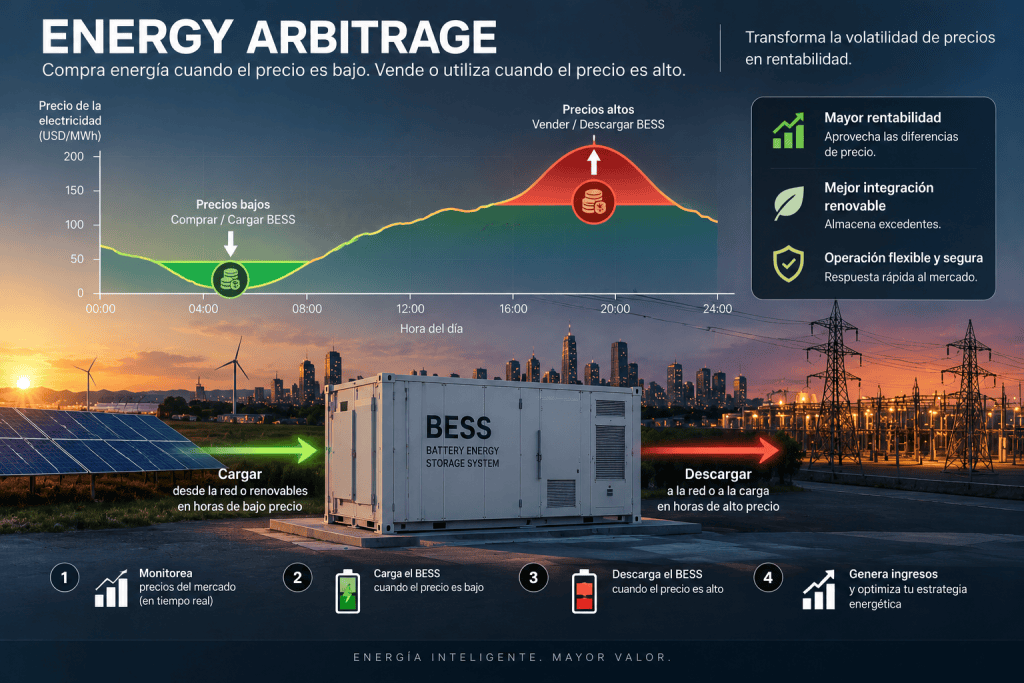
Load Shifting: It stores energy during cheap periods and uses it when the price increases.

Energy Arbitrage: Buy/charge when electricity is cheap and discharge when it increases.
Electrical backup: It maintains critical industrial processes during failures.

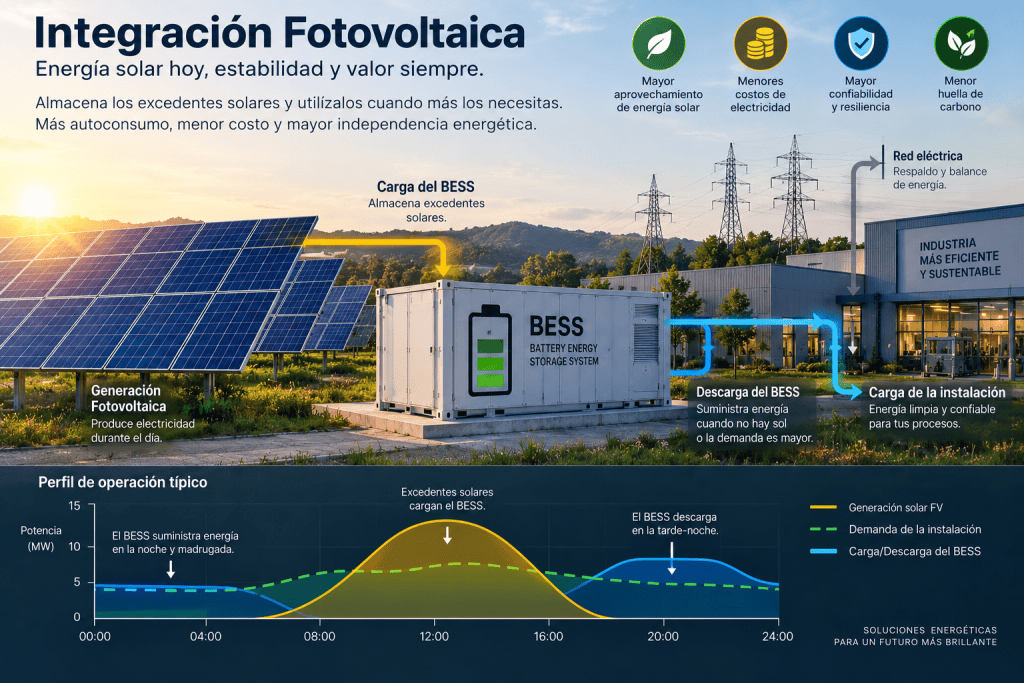
Photovoltaic integration: It stores excess solar energy for later use.
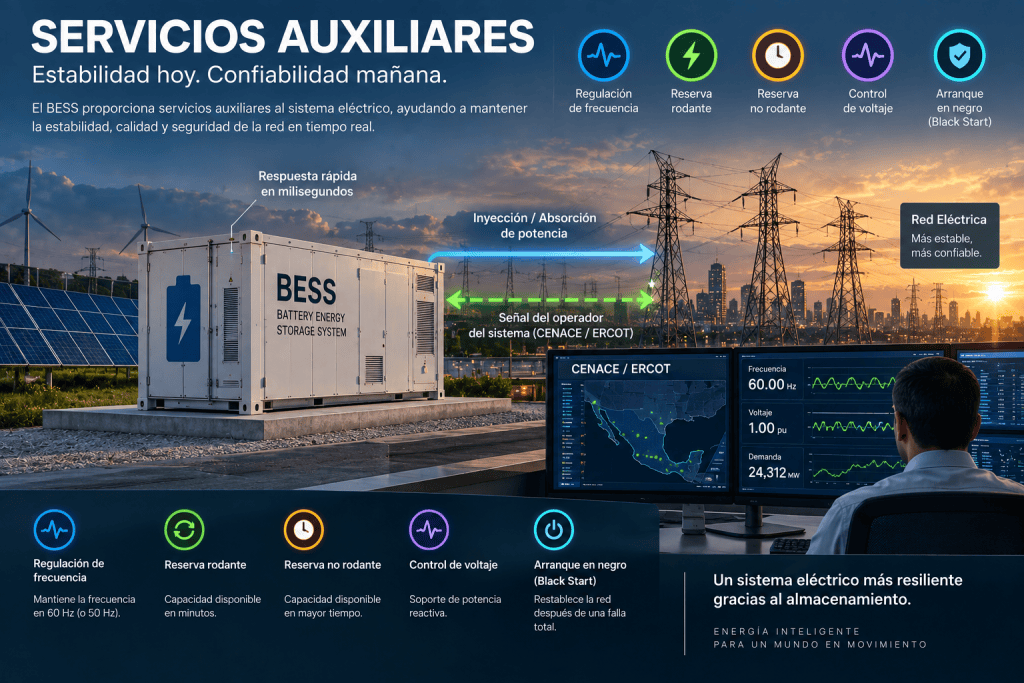
Frequency regulation: It responds quickly to frequency variations.

Ancillary services: It provides flexibility and stability to the network.
Congestion Management: It can reduce certain transmission restrictions.

Black Start / Grid Forming: Depending on its architecture, it can contribute to restoration and network formation.

Power Quality: It helps control rapid variations and certain electrical disturbances. Therefore, the true economic value of a BESS usually becomes apparent when it is implemented. Revenue Stacking, That is, when the same asset provides several services.

4. BESS in Mexico
Mexico is entering a much more defined regulatory stage for storage.
The Regulations of the Electricity Sector Law expressly recognize the Electrical Energy Storage Systems (EES) and allows their participation, whether or not associated with power plants and load centers, in addition to considering them for certain transmission and distribution functions.Official Gazette of Mexico)
Furthermore, in April of 2026 The National Energy Commission published new administrative provisions for the integration of SAEE into the National Electric System. These replaced the previous provisions published in March 2025.Official Gazette of Mexico)
Current regulations stipulate, among other things, that until market rules are fully adapted, a storage system can be treated as It acts as a Load Center when it draws electricity and as a Power Plant when it injects it.. (Official Gazette of the Federation)
This represents an important step forward for the commercial development of storage in Mexico.
Particularly interesting applications in Mexico
For Mexican industry, I consider the following projects particularly attractive:
Solar + BESS
to take advantage of surplus photovoltaic generation and shift it to hours of higher value.
BESS Behind-the-Meter
installed directly within industrial plants.
Peak Shaving
to control demand and optimize certain components of electricity costs.
Industrial microgrid
combining:
CFE/Grid + Solar + BESS + Emergency Generator + EMS.
This architecture is particularly interesting for installations where a power outage can represent production losses far exceeding the cost of energy.
5. Technical feasibility
From a technical point of view, a BESS project is highly viable, but its design must be tailored to the specific application.
It is not correct to simply decide:
“We need a 10 MW battery.”
The analysis should determine at least:
MW required → MWh required → duration → daily cycles → load profile → electricity prices → interconnection point → transformer capacity → short circuit → protections → harmonics → temperature → degradation → availability → fire safety.
Degradation is particularly important.
A battery gradually loses capacity as it accumulates cycles and ages. Therefore, a 15–20 year financial project must consider:
State of Health (SOH), Depth of Discharge (DoD), equivalent cycles, Round Trip efficiency, annual degradation, augmentation and module replacement.
6. Economic viability
The correct question is not simply:
“How much does a BESS cost?”
But:
How much money does each installed MWh generate, save, or protect over its entire lifespan?
Economic analysis should consider:
CAPEX
Batteries + PCS + EMS + transformers + switchgear + civil works + engineering + interconnection + security.
OPEX
Maintenance + software + insurance + replacement + degradation + auxiliary consumption.
And then calculate:
NPV — Net Present Value
IRR — Internal Rate of Return
Payback
LCOS — Levelized Cost of Storage
But there is another frequently ignored element:
Cost of Downtime
In an industrial plant, a power outage can halt entire production lines.
If an interrupt represents, for example:
$250,000 in losses, Avoiding just a few interruptions can completely transform the ROI of storage.
Therefore, for industrial clients, the analysis should include:
Energy Savings + Demand Savings + Arbitrage + Reliability Value + Avoided Downtime + Ancillary Services − CAPEX − OPEX − Degradation
Executive Conclusion
The BESSs are evolving from simple backup systems to become strategic electrical infrastructure assets.
Texas demonstrates this transformation: ERCOT went from 275 MW of storage in 2020 to 16,656 MW in 2025, and envisions around 49.6 GW by 2030 in its capacity outlook.Ercot)
Mexico is in an earlier but particularly interesting phase. The new regulatory framework of 2026 formally recognizes different forms of participation in energy storage and establishes mechanisms for its integration into the National Electric System (SEN). It even contemplates specific contracts with CENACE when these resources technically contribute to reliability, security, efficiency, or renewable integration.Official Gazette of Mexico)
The greatest industrial opportunity does not necessarily lie in selling batteries, but in selling reliability and energy optimization.
For an energy engineering company, the highest value proposition would be to structure the BESS as follows:
Energy diagnosis → technical-economic simulation → MW/MWh sizing → electrical engineering → interconnection → BESS supply → EMS → installation → commissioning → operation and maintenance.
In this way, the customer doesn't simply buy a battery: they buy cost reduction, operational continuity, resilience, and strategic control of your energy.
In terms of opportunity, Texas currently represents the most mature market for BESS monetization, while Mexico presents a particularly attractive growth window as the new 2026 storage regulatory framework is implemented.