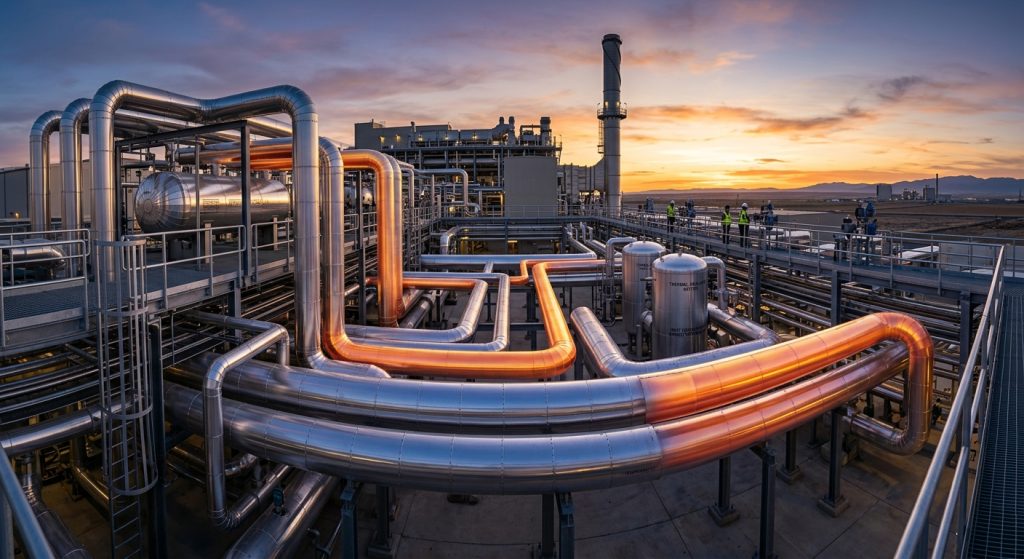
It is the mandatory regulatory framework in Mexico designed to ensure the sustainable use of energy by controlling heat losses and gains in industrial processes.
What is its main objective?
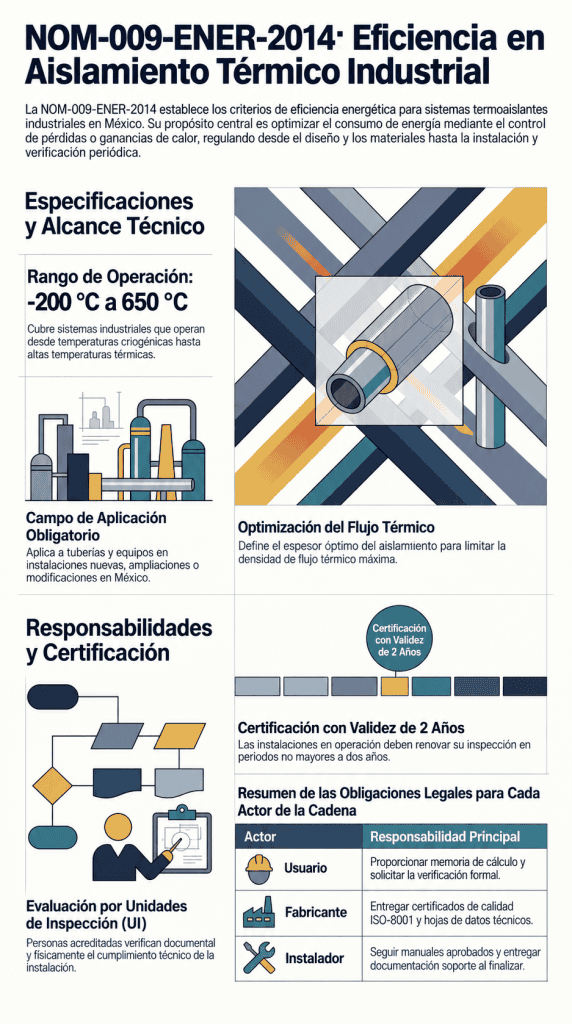
The central purpose of this standard is regulate and establish the energy efficiency of industrial thermal insulation systems. This is achieved by limiting heat transfer through a maximum allowable heat flux density. In this way, the aim is to optimize fuel and electricity consumption for production processes throughout the installation's lifespan.
Scope and exclusions
NOM-009-ENER-2014 is applicable to:
- All industrial facilities located in the Mexican Republic that use thermal insulation to conserve heat in pipes and equipment.
- Facilities new additions, extensions or modifications of the existing ones.
- Services that operate in extreme temperature ranges from 73.15 K (-200 °C) to 923 K (650 °C).
What does this standard not cover? Excluded are systems based on refractory materials or ceramic fibers, insulation for residential buildings, domestic refrigerators, air conditioning, ventilation systems, sound control, and fire protection. Also excluded are areas where there is a risk of personnel coming into contact with surfaces at temperatures equal to or greater than [temperature missing in original text]. 333 K (60 °C) But if heat conservation is not required by the process, physical protection barriers must be installed that will not be subject to the heat conservation evaluation.
Pillars of technical compliance
To achieve efficient operation under the standard, clear methodologies are defined:
- Insulation thickness: The calculation of the optimal thickness is derived from an economic balance between the cost of the thermal insulation system and the cost of wasted energy. The calculation methods are based on the international standard. ISO 12241 and the standard ASTM C680.
- Material properties: Insulating materials must withstand the passage of heat, maintain their dimensions and constant conductivity, have an alkaline pH to prevent metal corrosion, be asbestos-free, and be non-toxic.
- Installation criteria: It requires detailed manuals and trained personnel to avoid thermal bridges and ensure correct placement (for example, longitudinal joints offset by 90° between one layer and another).
Key responsibilities of the actors
The NOM distributes specific obligations among the participants in the sector:
- Users (Industrial): They must possess the calculation records, maintain a complete inventory of insulated pipes and equipment, and perform measurements to assess thermal efficiency. at least once every two years.
- Manufacturers: They are required to provide quality certificates for each production batch and to provide safety data sheets.
- Installers: They must work under approved manuals and provide the user with a signed document that guarantees full compliance with the standard.
Verification and Benefits
The enforcement of this NOM falls to the Ministry of Energy (SENER) through the National Commission for the Efficient Use of Energy (CONUEE). Compliance with the standard is verified by Inspection Units (UI) accredited. Upon successful completion of the inspection, a Certificate of Conformity which has a validity of two years.
Key benefits of compliance:
- Economic: Drastic reduction in fuel and electricity spending.
- Environmental: Lower emissions of polluting gases that cause global warming and acid rain.
- Security: Effective protection of operators against burns in high-temperature pipes and equipment.