
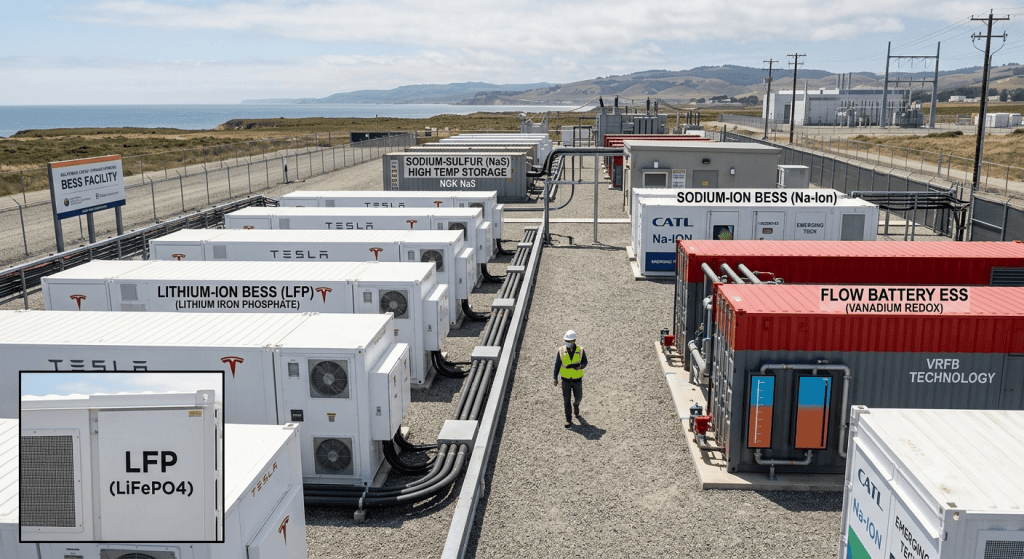
Battery technologies used in BESS
Globally, the market for battery energy storage systems (BESS) is massively dominated by electrochemical technologies, although different chemistries coexist depending on the application (network support, energy arbitrage, frequency regulation or industrial backup).
The most commonly used battery technologies today are classified as follows:
1. Lithium-Ion Batteries
It is the undisputed leading technology, capturing more than 90% of the global market modern BESS systems are popular due to their high energy density, high efficiency (generally >90%) and rapid cost reduction in recent years. Within the lithium-ion, two sub-chemistries dominate:
-
LFP (Lithium Iron Phosphate – $LiFePO_4$): It has become the industry standard for stationary BESS. Although it has a lower energy density than other lithium chemistries, it stands out for its excellent thermal stability (fire safety), lower cost (by not using cobalt or nickel) and a long lifespan (more than 4,000 to 6,000 cycles).
-
NMC (Nickel, Manganese and Cobalt – $LiNiMnCoO_2$): Very common in electric vehicles and used in the first BESS megaprojects (such as Tesla's Hornsdale Power Reserve in Australia). It offers superior energy density, but its use in stationary storage has declined compared to LFP due to concerns about the cost of raw materials and the risk of thermal runaway (thermal runaway).
2. Flow Batteries
Unlike conventional batteries, they store energy in liquid electrolytes contained in external tanks. They are the fastest growing option for applications of long duration (LDES) (downloads from 6 to more than 12 hours).
-
Vanadium Flux (VRFB): She is the most mature in this category. Its main advantage is that They do not degrade with charge/discharge cycles (they can last more than 20 years without losing capacity) and storage capacity can be scaled up simply by increasing the size of the electrolyte tanks. They have lower efficiency (~70-80%) and a higher initial cost, but excellent long-term levelized cost of storage (LCOE).
-
Other flow technologies: Variants based on Iron-Chromium or Zinc-Bromine are gaining ground as alternatives with lower geopolitical and environmental costs.
3. Sodium-based Batteries
Sodium is emerging as the main competitor to lithium in the immediate future due to the abundance and low cost of the raw material.
-
Sodium-Ion (Na-Ion): In the midst of a massive industrial scaling process. Its performance and density properties are very similar to those of first-generation LFP batteries, but with a superior safety profile in extreme temperatures and a potentially lower production cost.
-
Sodium-Sulfur (NaS) / Sodium-Nickel Chloride (NaNiCl – “Zebra Batteries”): These are high-temperature technologies (they operate above the 250°C). NaS batteries, popularized commercially by NGK in Japan, have been used in large-scale grid applications for decades due to their high density and zero self-discharge, although their thermal management requires complex systems.
4. Advanced Lead-Acid and Nickel Batteries
Although they are mature technologies, their presence in new large-scale BESS projects is marginal.
-
Advanced Lead-Acid (VRLA / Carbon-Lead): They remain relevant in rural microgrids, behind-the-meter (BTM) applications, and critical backup systems due to their very low initial cost and high recyclability. However, their short lifespan under deep cycling and low energy density exclude them from large-scale grid projects.
-
Nickel-Cadmium (Ni-Cd) and Nickel-Metal Hydride (Ni-MH): Virtually obsolete for modern BESS, limited to industrial environments with extreme climatic conditions (such as substations in arctic or desert areas) due to their high thermal robustness.